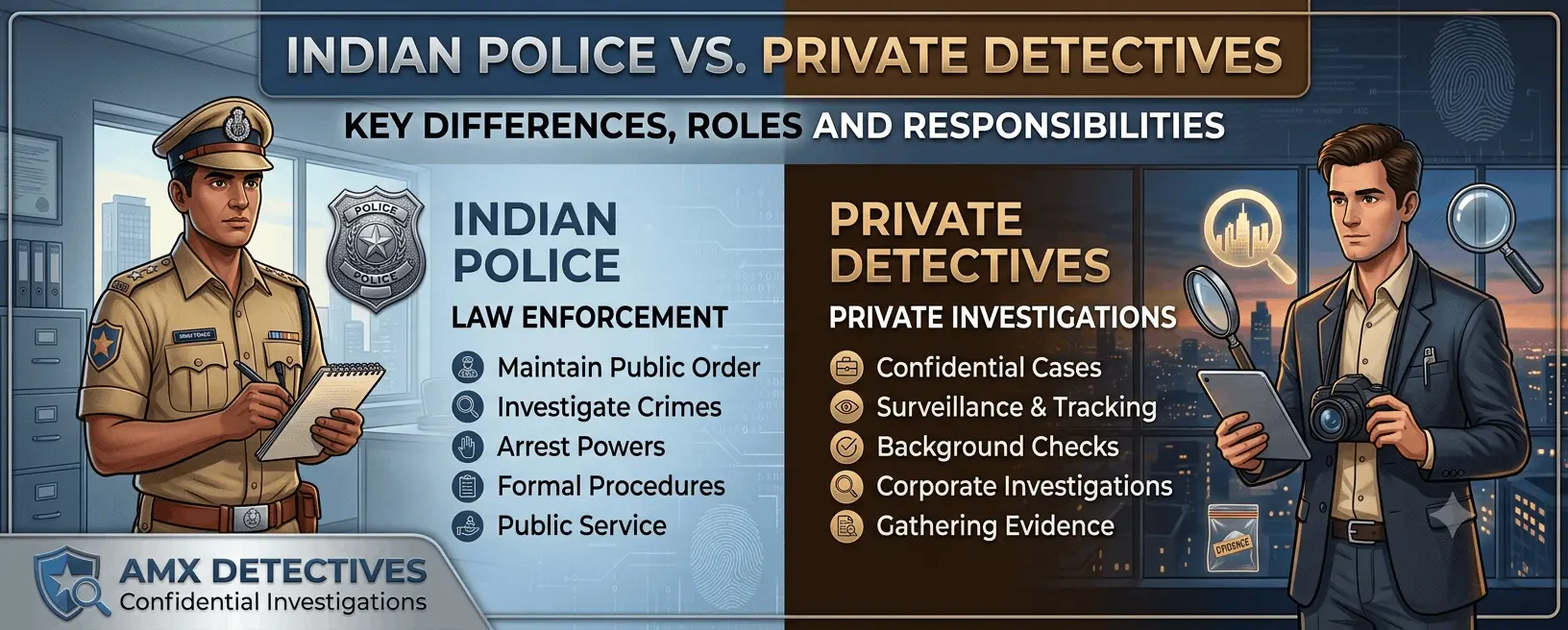
People sometimes need help finding reliable answers to sensitive personal or professional problems. These situations may involve suspected fraud, matrimonial concerns, employee misconduct, background verification, or a missing family member. One common question is whether to contact the police or seek assistance from a private detective agency.
Although both may work to uncover facts, their responsibilities, legal authority, and investigative methods are different. The Indian police are responsible for law enforcement, public safety, and investigating criminal offences. Private investigators, on the other hand, assist clients with lawful fact-finding, background checks, surveillance, and other private investigative requirements within the limits of applicable law.
Understanding these differences can help individuals and businesses choose an appropriate course of action.
1. Purpose and Primary Responsibilities
The most important difference between the police and private detectives is the authority under which they operate and the purpose of their work.
Role of the Indian Police
The Indian police are public law enforcement authorities responsible for maintaining law and order, responding to criminal complaints, preventing crime, and investigating offences. Their responsibilities are governed by applicable laws, including the Bharatiya Nagarik Suraksha Sanhita (BNSS), 2023, and other relevant legislation.
Police intervention is particularly important when a person faces threats, violence, theft, fraud, harassment, or another suspected criminal offence. Depending on the circumstances and applicable law, the police can investigate complaints and take legally authorized action.
Role of Private Detectives
Private detectives work with individuals, families, and businesses that need information about a particular matter. Their work may include pre-matrimonial background verification, employee background checks, corporate due diligence, discreet observation, and gathering information from lawful sources.
A professional private detective agency focuses on the client’s specific requirements while respecting privacy, legal restrictions, and the rights of other people.
For example, someone considering a marriage may want to verify certain background details before making a decision. A private investigator may help check relevant information through lawful methods. However, if the concern involves threats, violence, or suspected criminal activity, contacting the police may also be necessary.
2. Legal Powers and Investigative Methods
Police officers and private investigators do not have the same legal powers. Understanding this distinction is essential before choosing an investigation service.
Legal Powers of the Police
Depending on the offence and applicable legal requirements, police officers may be authorized to arrest individuals, conduct searches, seize evidence, question people as permitted by law, and submit investigation reports to the appropriate court or authority.
These powers are subject to statutory safeguards, procedural requirements, and judicial oversight where applicable.
What Private Investigators Can Do
Private investigators do not possess police powers simply because they work in the investigation field. They cannot exercise police arrest powers, force entry into private property, or access private communications without lawful authority.
Depending on the assignment, lawful investigative activities may include:
- Conducting background verification using legitimate sources.
- Reviewing publicly available information and records.
- Observing activities from places where such observation is lawful.
- Carrying out corporate due diligence and employee verification.
- Documenting relevant findings through lawful methods.
- Preparing factual reports for clients and, where appropriate, their legal advisers.
A reputable private detective agency in Mumbai, Delhi, Ghaziabad, or another city should clearly explain what its investigation can and cannot legally involve before accepting a case.
3. Scope of Cases Handled
The types of cases each party accepts highlight clear operational differences:
| Investigation Area | Indian Police Force | Private Detective Agencies |
| Criminal Matters | Murder, robbery, extortion, physical assault, cybercrime. | Pre-trial evidence gathering, parallel fact-finding for defense. |
| Personal Matters | Dowry harassment, domestic violence, and registered missing persons. | Matrimonial checks, marital infidelity, covert background checks. |
| Corporate Matters | Large-scale economic fraud, financial embezzlement. | Due diligence, asset tracing, employee background screening. |
| Jurisdiction | Bound strictly by police station limits and state borders. | Nationwide and international flexibility without territorial limits. |
For personal matters where legal violations have not yet occurred, law enforcement cannot intervene. In these situations, hiring private investigators in Delhi or neighboring regions offers a proactive way to uncover facts before taking legal action.
4. Confidentiality and Privacy
Privacy is an important consideration when dealing with sensitive personal or business matters. However, neither service should be understood as offering unrestricted secrecy.
Confidentiality in Police Matters
Police complaints and investigations follow formal legal procedures. Information may be shared with relevant authorities, courts, or other parties where the law requires or permits it. The level of public access depends on the nature of the record and applicable legal provisions.
People should not avoid reporting a serious crime simply because they are concerned about privacy.
Confidentiality in Private Investigations
Individuals and businesses often approach a private detective agency because they want their concerns handled discreetly. A professional agency should explain how client information, investigation records, photographs, and reports will be handled.
Confidentiality commitments should be documented where appropriate, but they are not a guarantee of absolute secrecy in every circumstance. Legal obligations and valid disclosure requirements may still apply.
Whether you approach a detective agency in Gurgaon, a private detective agency in Noida, or an investigation firm in another city, ask about its privacy practices before sharing sensitive information.
5. Time, Attention and Flexibility
The time required for an investigation depends on the facts, available evidence, urgency, and complexity of the case.
How Police Prioritize Cases
Police departments handle a wide range of public safety responsibilities and reported offences. The urgency and progress of a particular investigation depend on its circumstances, legal requirements, available resources, and other operational considerations.
How Private Investigators Manage Assignments
Private investigators generally organize their work around the specific scope agreed upon with a client. Depending on the assignment, this may include background verification, field enquiries, lawful observation, and periodic progress reports.
For example, a business seeking employee verification may need a focused review of employment history and credentials. A private investigator can explain the proposed checks, expected timelines, limitations, and reporting process before beginning the assignment.
No professional agency should guarantee a particular result or promise that every case can be resolved within a fixed period.
6. Can Private Detectives and Police Work Together?
Yes. Their roles can complement each other when a situation requires both private fact-finding and official law enforcement.
A private investigator may gather relevant information through lawful means and provide a factual report to the client. If the findings suggest a criminal offence, the client can share relevant information with the police or consult a qualified lawyer about the appropriate next steps.
The police independently assess the information and decide what action is warranted under applicable law. Information collected by a private investigator is not automatically admissible in court; its use depends on the circumstances, the method of collection, and applicable evidentiary rules.
This distinction is particularly important in corporate disputes, suspected fraud, and sensitive personal matters.
7. Should You Contact the Police or Hire a Private Detective?
The right choice depends on the nature of your concern.
Contact the police if you are experiencing violence, threats, theft, suspected criminal fraud, stalking, or another situation requiring official intervention. If there is immediate danger, seek emergency assistance rather than waiting for a private investigation.
Consider a private detective when you need lawful background verification, pre-matrimonial checks, corporate due diligence, employee verification, or discreet fact-finding that falls within the agency’s legitimate scope.
In some situations, both options may be appropriate. A private investigator can assist with a specific information-gathering requirement, while the police handle matters that fall within their law enforcement responsibilities.
Conclusion
Indian police officers and private detectives serve different but sometimes complementary purposes. The police have statutory responsibilities and legal powers to address criminal offences and protect public safety. Private investigators provide specialized, client-focused fact-finding services within the boundaries of applicable law.
Before hiring an investigation agency, clarify your objectives, ask about the methods it intends to use, understand its confidentiality policies, and request transparent information about fees and timelines. Choosing the right approach can help you make informed decisions while respecting the law and the privacy of everyone involved.
Frequently Asked Questions (FAQs)
1. What is the main difference between the Indian police and a private detective?
The police are public law enforcement authorities responsible for public safety and investigating criminal offences. Private detectives provide lawful investigative and fact-finding services to individuals and businesses for specific personal or professional requirements.
2. Can a private detective arrest someone in India?
No. Private detectives do not have police arrest powers. They must not represent themselves as law enforcement officers or exercise powers reserved for authorized authorities.
3. When should I contact the police instead of a private detective?
Contact the police when you suspect a criminal offence, face threats or violence, need to report a missing person, or require urgent official intervention. Immediate safety concerns should always take priority over private fact-finding.
4. What services can a private detective agency provide?
Depending on the agency and the assignment, services may include pre-matrimonial background verification, employee verification, corporate due diligence, background checks, and lawful surveillance or information gathering.
5. Are private detective services legal in India?
Private investigative activities must comply with applicable laws, including privacy protections and restrictions on unauthorized access, surveillance, and data collection. The legality of a particular method depends on the circumstances. Clients should choose agencies that explain their legal boundaries clearly. Read more
6. Is information collected by a private investigator admissible in court?
Not automatically. The court determines whether information or evidence can be considered under applicable law. Its relevance, authenticity, collection methods, and compliance with legal requirements may affect its use.
7. Can a private detective help with a matrimonial investigation?
A private investigator may conduct lawful pre-matrimonial background checks and other agreed fact-finding activities. The agency should respect privacy, avoid unauthorized access to personal information, and clearly explain the scope of its services.
8. Can private detectives investigate corporate fraud?
They may assist with lawful corporate due diligence, background checks, and limited fact-finding into suspected misconduct. Serious suspected criminal offences should also be reported to the appropriate authorities where necessary.
9. Do private detective agencies guarantee confidentiality?
Professional agencies should have clear confidentiality and data-handling policies. However, absolute secrecy cannot be guaranteed in every circumstance, particularly where disclosure is legally required.
10. Can I hire a private detective in Delhi, Gurgaon, Noida, or Mumbai?
You can approach agencies that offer services in these locations. Before hiring one, confirm its local operational capability, experience with your type of case, proposed investigative methods, pricing, and privacy practices.